



The rising issue of methane emissions from landfills
Did you know that landfills were responsible for around 24% of total UK methane emissions in 2022?
Methane is a potent greenhouse gas which can be released into our atmosphere through both natural and human-driven processes. It is over 25 times more effective at trapping heat in the atmosphere than carbon dioxide over a 100-year period, significantly contributing to global warming and climate change. Therefore, to fulfil the government’s goal of becoming net zero by 2050, we must address the rising issue of methane emissions from landfills.
In today’s blog, we explore the real impact of landfill methane emissions, and share how responsible waste management can help you contribute to a more sustainable future.
Methane emissions from landfills: problems and solutions
Why are methane emissions from landfills a problem?
When biodegradable waste such as food scraps, garden cuttings, and paper ends up in landfill, it decomposes without oxygen. This process, known as anaerobic decomposition, generates methane gas, which escapes into the atmosphere unless captured. This is a major issue in the UK where we still send millions of tonnes of municipal solid waste to landfill each year.
As well as harming our environment, the build up of methane can pose serious health risks, leading to unpleasant odours and reduced air quality for nearby communities. It can also increase the risk of fire or explosions in landfill sites due to the gas’ flammability.
Businesses that continue to send biodegradable waste to landfill are missing out on vital opportunities to extract economic and environmental value from waste materials that could instead be recycled, composted, or converted into renewable energy.
How to reduce methane emissions from landfills
1) Segregate your waste at the source
Ensure that all your waste streams are clearly labelled depending on the waste type i.e. general waste, recyclables, food waste, glass waste, and provide regular training for your staff to help them understand what goes where. By encouraging consistent waste separation at the source, you are helping to make recycling easier and reduce the amount of biodegradable material sent to landfill.
2) Effectively manage your organic waste
If you have a garden or food waste bin, make sure you use it regularly. This will ensure that any organic materials like peelings, leftovers, grass cuttings, and soil are properly composted rather than being sent to landfill. If these services aren’t readily available in your area, consider working with a licensed commercial water provider to introduce them in your premises.
3) Reduce your food waste
According to official government statistics, over ten million tonnes of food is wasted every year in the UK – the majority of which ends up in landfill. It’s vital that you start seriously thinking about how much food your home or business throws away. Planning meals in advance, using up leftovers, and donating excess ingredients can help reduce the amount of organic waste you produce and cut down on methane gas emissions.
4) Introduce circular waste systems
Try to find ways to reuse or recycle your organic materials instead of throwing them away. For example, you could collect used coffee grounds and repurpose them as compost, or turn food scraps into biogas through anaerobic digestion. By supporting the creation of new products from recycled materials, you are helping to reduce the amount of waste sent to landfill.
5) Support local community initiatives
Get involved with local initiatives that are aimed at reducing landfill waste. Examples of these could include supporting community compost schemes or setting up educational workshops to raise awareness about responsible waste disposal and global methane emission reduction. These small actions can lead to big changes when it comes to minimising landfill gas emissions.
Reduce the environmental impact of your waste with McCarthy Marland
At McCarthy Marland, we help businesses across the South of England to reduce their reliance on landfill and manage their waste more sustainably.
We offer a wide range of commercial waste collection services, such as wheeled bin hire, skip hire, RoRo skip hire, compaction systems, and grabber/tipped hire, that are designed to boost recycling rates and divert waste away from landfill – a win for both the planet and your reputation.
We are committed to reducing our environmental impact at every stage of the waste collection and disposal process, and are extremely proud to achieve an average recycling rate of 95% across our four waste transfer stations. Our state-of-the-art waste segregation technology allows us to recover as much recyclable material as possible for reprocessing and reuse, with all remaining residual waste being sent for energy recovery.
Ready to make your business’ waste more sustainable? Contact us to discuss your waste management needs.
Locking wheelie bins: a secure solution for commercial waste management
Did you know that wheelie bins are an attractive target for criminals? Criminals often sift through unsecured bins to access confidential materials, valuable recycles, and hazardous waste that can be stolen or dumped elsewhere. Unlocked bins can also attract fly-tippers and become an easy target for arson and vandalism.
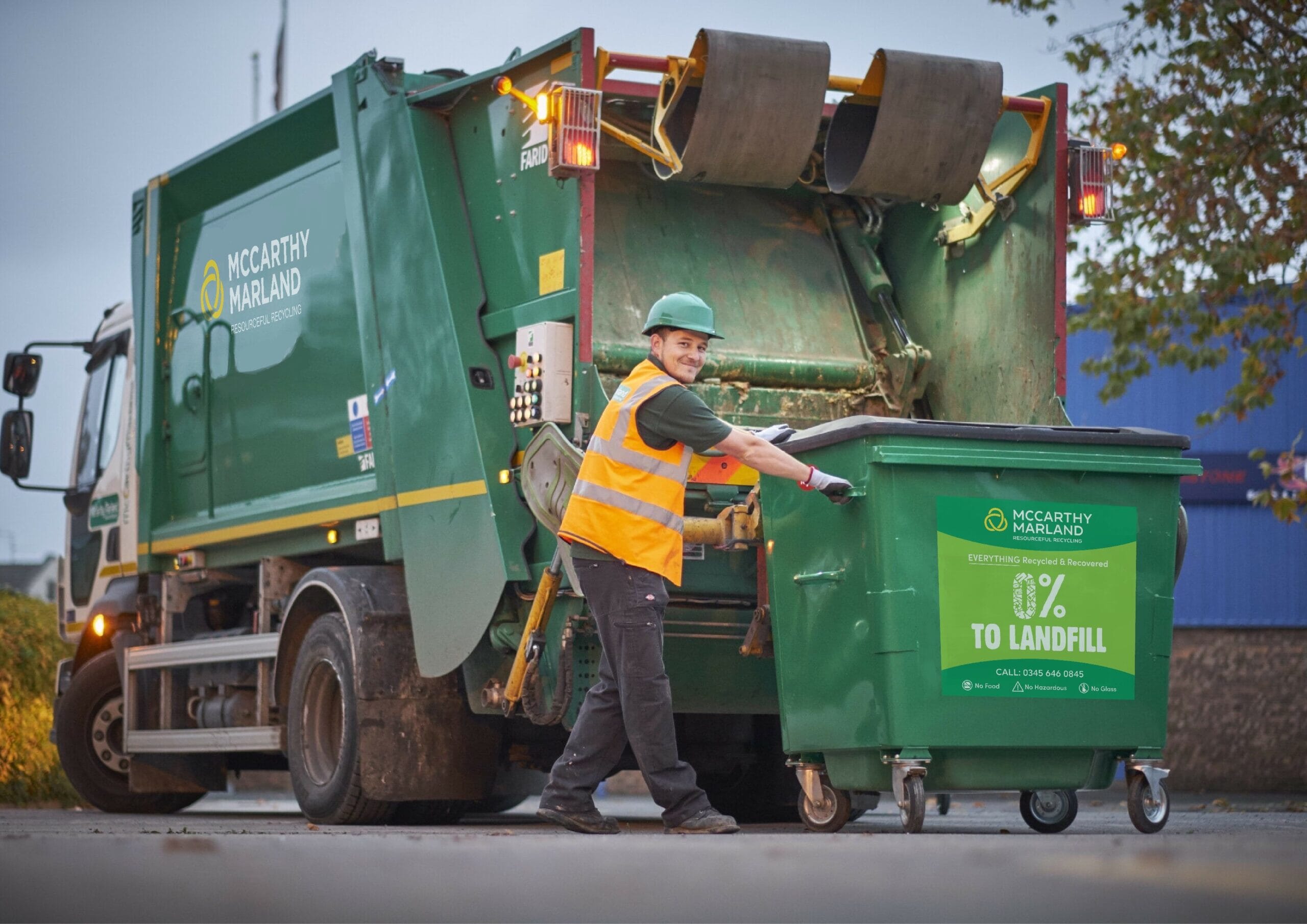
At McCarthy Marland, we supply a wide range of locking wheelie bins to help deter thieves and keep your waste firmly where it belongs. Here’s why you should choose our locking wheelie bins to manage your commercial waste.
What are locking wheelie bins?
Locking wheelie bins are wheeled waste containers that are equipped with secure locking mechanisms on the lid. These locks are designed to prevent unauthorised access and ensure that your waste remains protected until the bin is emptied. Locking wheelie bins are available in various sizes and can house a wide range of waste materials, including general waste, recyclables, and hazardous materials.
The locking mechanisms can range from simple clasp systems to integrated key locks, depending on the level of security needed. They are still as practical as standard industrial bins with wheels, but with the added peace of mind that your waste is not being tampered with.
Who should use locking wheelie bins?
A wide range of businesses use locking industrial wheelie bins, including:
- Construction sites that need to securely contain their building materials, rubble, and packaging waste
- Industrial premises that wish to prevent unauthorised scavenging of waste
- Retail units that are looking to deter the public from misusing their bins
- Hospitality venues that need to manage their food and packaging waste
- Offices that handle confidential documents or recyclable paper
Why choose locking wheelie bins?
Here are eight key reasons why you should choose locking wheelie bins for your site:
1) Prevent unauthorised access
Locking lids help to deter trespassers and opportunistic thieves who may scavenge or tamper with your waste. This is particularly important if you regularly dispose of confidential materials or valuable recyclables.
2) Stop fly-tipping
Members of the public or neighbouring businesses will not be able to illegally dump their waste in your locked bin, saving you both time and money in clean-up or collection costs.
3) Protect against pests and vermin
Unsecured bins can attract unwanted guests such as seagulls, foxes, and rats. By fitting locks on your bins, you prevent pests from tearing open your bin bags and scattering waste around your site.
4) Reduce fire risks
Arson attacks on wheelie bins are not uncommon, especially in urban or industrial areas. Lockable bins restrict access to your waste, helping to mitigate the risk of arson.
5) Maintain a professional image
Overflowing or misused bins look unsightly, which can be damaging to your business’ image. By securely containing your waste, you are showing customers and stakeholders that your business takes cleanliness and compliance seriously.
6) Avoid unpleasant odours and spills
A locked lid keeps smells contained and prevents your waste from spilling out due to wind or vandalism. This keeps your site clean and hygienic, as well as improving working conditions for your staff.
7) Comply with waste regulations
If your business regularly handles sensitive or hazardous materials, locking bins can help you comply with environmental regulations and avoid hefty fines associated with non-compliance.
8) Increase recycling rates
By securely containing your waste, locking bins ensure that your materials remain free from contamination and can be properly processed for recycling.
Discover our comprehensive range of locking wheelie bins
At McCarthy Marland, we offer commercial and industrial wheelie bins with lockable lids in the following sizes:
- 660-litre recycling and recovery bins for mid-sized businesses
- 1,100-litre recycling and recovery bins for larger enterprises
Every locking wheelie bin in our range features a secure locking mechanism to keep your waste safe from tampering, theft, or contamination. Our bins are built from tough, weather-resistant materials with reinforced wheels for smooth manoeuvring, even when fully loaded. They can be easily moved around your site and collected at a time that suits you, ensuring minimal disruption to your business operations.
Get in touch today to arrange your locking wheelie bin hire.
How compaction systems can help your industrial business reduce waste
Did you know that the UK’s industrial sector generated 12.4 million tonnes of waste in 2020? Today’s industrial sector is now under increasing pressure to operate more sustainability, thanks to tightening regulations and mounting waste disposal costs. Knowing how to reduce your industrial waste is an essential requirement in 2025.
Compaction systems are extremely effective at reducing your industrial waste volume and streamlining your business’ operations. In today’s blog, we’ll explore how compaction systems work and why they’re a smart investment for any industrial operation.
What are compaction systems?
A compaction or bailing system is a type of machinery that compresses waste materials into smaller, denser units. They are capable of handling large volumes of bulky waste, such as general waste, paper, wood, polythene, plastics, cardboard, and glass. By significantly reducing volumes of waste, these systems help businesses cut down the number of waste collections required, helping to save both time and money.
The benefits of reducing waste with compaction systems
1) Reduced waste collection costs
Compaction systems work by compressing your waste into smaller units, which allows you to place more material in each container. This means that your waste doesn’t need to be collected by a licensed waste carrier as frequently as it would with other waste disposal methods, helping to save you money on transport costs and fuel. Over time, these cost savings can significantly boost your bottom line, especially when operating across multiple sites.
2) More efficient use of space
If your industrial site produces huge volumes of bulky waste, you may find that you often run out of space quickly. Without an effective system in place, waste can soon pile up and occupy key areas that are needed for business operations. Compaction systems help solve this issue by compressing waste into smaller loads, which dramatically reduces the amount of space you need for on-site storage.
3) Improved health and safety
Loose waste that has been discarded around your site can quickly become a serious health and safety issue. Your waste can create tripping hazards for your workers and even pose a fire risk, especially when materials like paper, cardboard, and wood are involved. Compaction systems help to keep all your waste contained in a secure and tidy location, which reduces the likelihood of accidents and improves safety standards across your site.
4) Increased recycling rates
Compaction systems also support effective recycling. With the right equipment, you can easily separate recyclable materials such as cardboard, plastic, and metals, and compress them into high-density bales that are recycle-ready. By investing in a compaction system, you’re helping to minimise your environmental impact, preserve natural resources, reduce the amount of waste sent to landfill, and give your materials a second lease of life.
Discover our comprehensive range of compaction systems
Searching for a reliable compaction system supplier for your industrial site? At McCarthy Marland, we recognise that every site is different – that’s why we offer two main types of compaction systems that are specifically tailored to your business needs:
- Static compactors – ideal for sites that consistently generate high volumes of waste)
- Portable compactors – perfect for businesses that produce mixed types of waste and need flexible placement)
We also offer the following balers for dry packaging materials like cardboard, paper, and plastics:
- Vertical balers in single-chamber (for baling a single waste stream) or multi-chamber (multiple units to process two or more waste streams) varieties
- Horizontal balers, also known as mill sized balers – for operations that generate large quantities of a single waste stream
But we don’t just supply equipment. We also work with you to find smarter and greener ways to reduce your industrial waste at the source. We are always happy to offer advice on ensuring responsible commercial and industrial waste management, and we can also organise a wide range of alternative commercial waste collection solutions if required.
Ready to reduce waste at your industrial site?
If your industrial site is generating high volumes of waste and struggling with storage, then one of our compaction or baling systems could be just what you need. Whether you wish to increase your recycling rates or reduce site safety, our compaction systems can help you hit your waste reduction targets with confidence.
Contact us today to discover how we can help reduce your industrial waste.
The cost benefits of wheelie bin hire for small businesses in the UK
From retail shops and independent cafés to busy offices and warehouses, the daily operations of any small business can generate substantial amounts of waste. There’s a common misconception that disposing of business waste is expensive; but with options like wheelie bin hire available, managing your waste doesn’t need to break the bank.
At McCarthy Marland, we provide a wide range of affordable commercial wheelie bin hire services that take the hassle out of waste disposal. Here’s a closer look at the cost benefits of wheelie bin hire for small businesses, so you can start saving both time and money.
Affordable waste management solution
One of the biggest benefits of wheelie bin hire is its cost-effectiveness. Rather than investing in your own bins or paying unpredictable fees for ad-hoc skip collections, hiring a wheelie bin provides you with a fixed cost that you can easily work into your budget.
We are extremely transparent when it comes to wheelie bin hire prices, and there’s no hidden fees to worry about. Because we offer a wide range of wheelie bin sizes, from 240 litres all the way up to 1100 litre wheelie bins, you can choose the right bin for the volume of waste you expect to produce. Our large wheelie bin hire options are perfect for companies with substantial waste requirements, as they help to keep costs down by reducing the frequency of collections.
Time is money – save both with wheelie bin hire
Organising your waste collections can be time-consuming, especially if you’re having to rely on public services or make trips to the tip yourself. When you switch to commercial wheelie bin collection, you free up so much time that can be put back into other areas of your business.
At McCarthy Marland, we offer scheduled collections that are tailored to your business hours. This minimises disruption to your daily operations and eliminates any last-minute panics to sort out your rubbish. That leaves you with more time to do what you do best, and less time worrying about those unsightly bin bags piling up behind the scenes.
Health and safety matters
Space is a significant issue facing many small businesses. Whether you’re operating from a small industrial unit or a busy high street shop, clutter and mess can have a detrimental impact on the health and safety of both your employees and the public.
Our wheelie bins are designed to be robust and secure, giving you a centralised place to store your waste in between collections. If you’re generating different types of waste, such as general, recyclable, glass, or food waste, we can provide multiple labelled bins to keep your premises organised. We also offer lockable lids, which protect against unwanted smells, pests, and fly-tipping.
Flexible contracts that fit your business
At McCarthy Marland, we appreciate that no two small businesses are the same, which is why we offer flexible contracts that are specifically designed to suit your budget and waste requirements. Whether you need short-term wheelie bin hire or a long-term waste collection service, we’ll work with you to build a plan that perfectly suits your needs.
There’s no need to worry if your waste needs change either. Our services are totally flexible, meaning you can scale your bin size or collection frequency up or down to suit your business requirements. Read our blog on how to choose the right wheelie bins for your business needs for further advice.
Doing the right thing for the planet
Being eco-conscious is no longer just a nice-to-have. By hiring your wheelie bins from McCarthy Marland, you can rest assured that your business is contributing to more sustainable waste practices.
Take our recycling & recovery wheelie bin hire service, for example. All recoverable and recyclable waste (excluding food and glass) can be bundled together in one container, which is then sorted at our dedicated waste recycling facilities. We achieve an average recycling rate of 95% across all our facilities, with any remaining residual material processed as Refuse Derived Fuel (RDF). It’s all part of our sustainable service tailored to your business.
Hire your commercial wheelie bins from McCarthy Marland
Choosing the right commercial wheelie bin provider might seem like a small decision; but it can make a huge difference to your business’ bottom line. At McCarthy Marland, we are proud to work with small businesses across the South of England, providing dedicated bins for all waste types at affordable prices. We’re always on hand to help you choose the right size and type of bin for your premises, and can offer advice on alternative commercial waste collection services, including hazardous waste collection, for more complex jobs.
Get in touch to discover more about how our wheelie bin services can help you save both time and money.
How wheelie bin waste collection helps you comply with UK waste regulations
Environmental legislation is getting stricter, and businesses across the UK are under increasing pressure to manage their waste more effectively. From general rubbish to food waste, every business has a legal obligation to store, handle, and dispose of their waste in a responsible manner.
Wheelie bin waste collection services offer a practical, compliant, and cost-effective solution for everyday waste management. Whether you’re running a restaurant, office, shopping centre, or construction site, wheelie bins help to reduce your environmental impact and ensure compliance with UK waste regulations, saving you from costly fines and operational headaches. Find out how below.
What are your legal waste obligations?
Under the Environmental Protection Act 1990, all UK businesses have a duty of care to ensure their waste is managed responsibly. This means you’re legally required to:
- Securely store your waste
- Ensure that your waste doesn’t cause harm to the environment or human health
- Arrange for your waste to be separately collected by a licensed waste carrier
- Complete and retain a waste transfer note for every collection
Failure to comply can result in a fine of up to £5000, or even prosecution.
Complying with UK food waste regulations
Food waste regulations in the UK are constantly changing. As of 31st March 2025, DEFRA’s new ‘simpler recycling’ regulations require all businesses to separate their food waste for collection, rather than sending it to landfill or incineration. This rule applies to UK hospitality venues, food manufacturers, supermarkets and more.
Don’t forget wheelie bin cleaning regulations
It’s not just what you put in your bin that counts. Wheelie bin cleaning regulations are designed to prevent the spread of bacteria, pests, and unpleasant odours for food and healthcare businesses. Keeping your wheelie bins clean and hygienic is part of good waste management practice, and in some cases it can be an essential health and safety requirement.
How do wheelie bins ensure compliance with UK waste regulations?
Wheelie bin waste collection is a key component in adhering to UK waste regulations. Wheelie bins help you correctly segregate materials into separate waste streams (general waste, recycling, food waste, glass waste), and ensure your waste is securely stored to prevent leaks, pests, and fly tipping. It’s also easier to identify and audit your waste when disposed of in a designated wheelie bin.
The wheelie bin regulations in the UK can vary depending on your local authority and type of waste produced, but general rules include:
- Keeping lids closed to avoid unpleasant odours and spillage of waste
- Clearly labelling your bins for different waste streams
- Avoiding overfilling your bins or leaving waste beside the bin
You can read more about best practices for using a commercial wheelie bin in our dedicated blog post.
Why choose McCarthy Marland as your wheelie bin waste collection partner?
At McCarthy Marland, we offer a wide variety of wheelie bins for hire across the South of England, from 240L all the way up to 1100L. All our wheelie bins are compliant with the current handling and storage standards. We also provide fully licensed, scheduled waste collections of our bins to suit your business needs.
We supply the following types of bins to businesses across the UK:
- General waste bins – ideal for all your non-recyclable waste and residual rubbish.
- Recycling & recovery bins – suitable for all mixed dry recyclables including paper, cardboard, plastics, and metals. We recover as much waste as possible during the collection process, and are proud to achieve an average recycling rate of 95% across all our facilities.
- Glass recycling bins – designed to safely store your bottles and jars without risk of breakage or contamination, so they can be recycled and reused again.
- Food waste recycling bins – all the food waste we collect is diverted for anaerobic digestion, helping to reduce methane emissions and generate renewable energy.
Discover more about choosing the right wheelie bin for your business needs in our blog post.
When you choose our wheelie bin waste collection service, you can also rest assured that we will handle all paperwork on your behalf. We can provide you with waste transfer notes and duty of care documents to demonstrate compliance with UK waste regulations, leaving you with one less thing to worry about.
Do you need help with your commercial waste?
Whether you’re a small independent business or a large commercial operation, we can help you navigate your waste responsibilities with confidence. We provide tailored bin hire services and reliable scheduled collections to make your waste management processes as simple as possible, and ensure you remain compliant with UK regulations.
Get in touch with our team today to discuss your commercial waste collection needs.
The emergence of waste-to-energy plants and alternative fuels
The role of waste-to-energy (WtE) plants and alternative fuels is becoming increasingly important. 18 million European citizens receive electricity from WtE each year, and the UK government and private sector are now investing heavily in WtE infrastructure as part of its broader commitment to sustainability and net zero – an investment that is only expected to grow. But what are waste-to-energy plants, and how do they contribute to sustainable waste management?
What are waste-to-energy plants?
Waste-to-energy (WtE) plants are facilities that convert non-recyclable waste into usable energy, typically in the form of electricity or heat. This dramatically reduces the volume of waste sent to landfill and contributes to our national energy supply.
This most common WtE method is incineration. Municipal solid waste (MSW) is burned at high temperatures to produce steam, which drives turbines to generate electricity. Emissions are carefully controlled to ensure that harmful pollutants are captured before they enter the atmosphere. Many of today’s incineration-based waste-to-energy facilities operate under strict environmental regulations, making them a cleaner and more efficient option than traditional landfill waste disposal.
But waste incinerators aren’t the only WtE solution – gasification and pyrolysis are also gaining traction. This involves using a combination of heat and chemical processes to break waste down into a gas that can be used as fuel. These methods create fewer emissions than conventional incineration, and can be adapted to process a wide range of waste materials.
Understanding alternative fuels
Alongside WtE plants, alternative fuels derived from waste are becoming a major focus area for the industry. Refuse-derived fuel (RDF) and solid recovered fuel (SRF) are two key examples. Made from processed waste such as plastic, paper, and textures, they are often used in industrial furnaces, cement kilns, and power stations as a replacement for fossil fuels. These fuels not only reduce reliance on traditional fossil fuels but also help to lower overall carbon emissions, making them an attractive option for industries looking to improve their sustainability.
Another major alternative fuel is biogas, which is produced by breaking down organic waste through anaerobic digestion. This process captures the harmful greenhouse gas methane and converts it into a renewable energy source. Biogas can be used to produce electricity and heat buildings, or it can be further refined into biomethane as an alternative to diesel.
Challenges and considerations
While waste-to-energy plants and alternative fuels offer clear benefits, they’re not without challenges. WtE facilities require significant investment, and public concerns about potential emissions and air quality mean that new developments must meet stringent environmental standards. Plants must use advanced filtration and emission monitoring systems to ensure compliance with these regulations, adding to the overall cost and complexity of these projects.
From a waste hierarchy perspective, waste reduction and recycling should always come first. WtE should be seen as a last resort for non-recyclable waste, rather than a replacement for effective recycling and reuse initiatives. As technology continues to advance, WtE plants must evolve to integrate more sustainable solutions, such as carbon capture and storage (CCS) or hybrid models that combine WtE with renewable energy sources. These innovations can improve efficiency and further reduce emissions.
Improve your waste management strategies with McCarthy Marland
At McCarthy Marland, we are committed to helping businesses take a more sustainable approach to waste management. With landfill tax costs set to rise in the UK from 1st April 2025, it’s more important than ever for businesses and local authorities to reduce their reliance on landfill and make the most of materials that would otherwise go to waste – and we offer a wide range of tailored solutions that can help you do just that.
We work with top industry specialists to divert non-recyclable materials away from landfill and instead direct them towards waste-to-energy plants. In terms of alternative fuels, we ensure that all combustible waste is processed into refuse-derived fuel (RDF) solutions. We also work with GENeco to convert food waste into biogas, helping to create renewable energy from materials that would otherwise decompose in landfill.
Do you need help improving your business’ waste management systems? Get in touch with our expert team today and get ready to turn waste into a resource rather than a problem.
Westcombe Waste, Valley Trading & Aasvogel join forces under McCarthy Marland
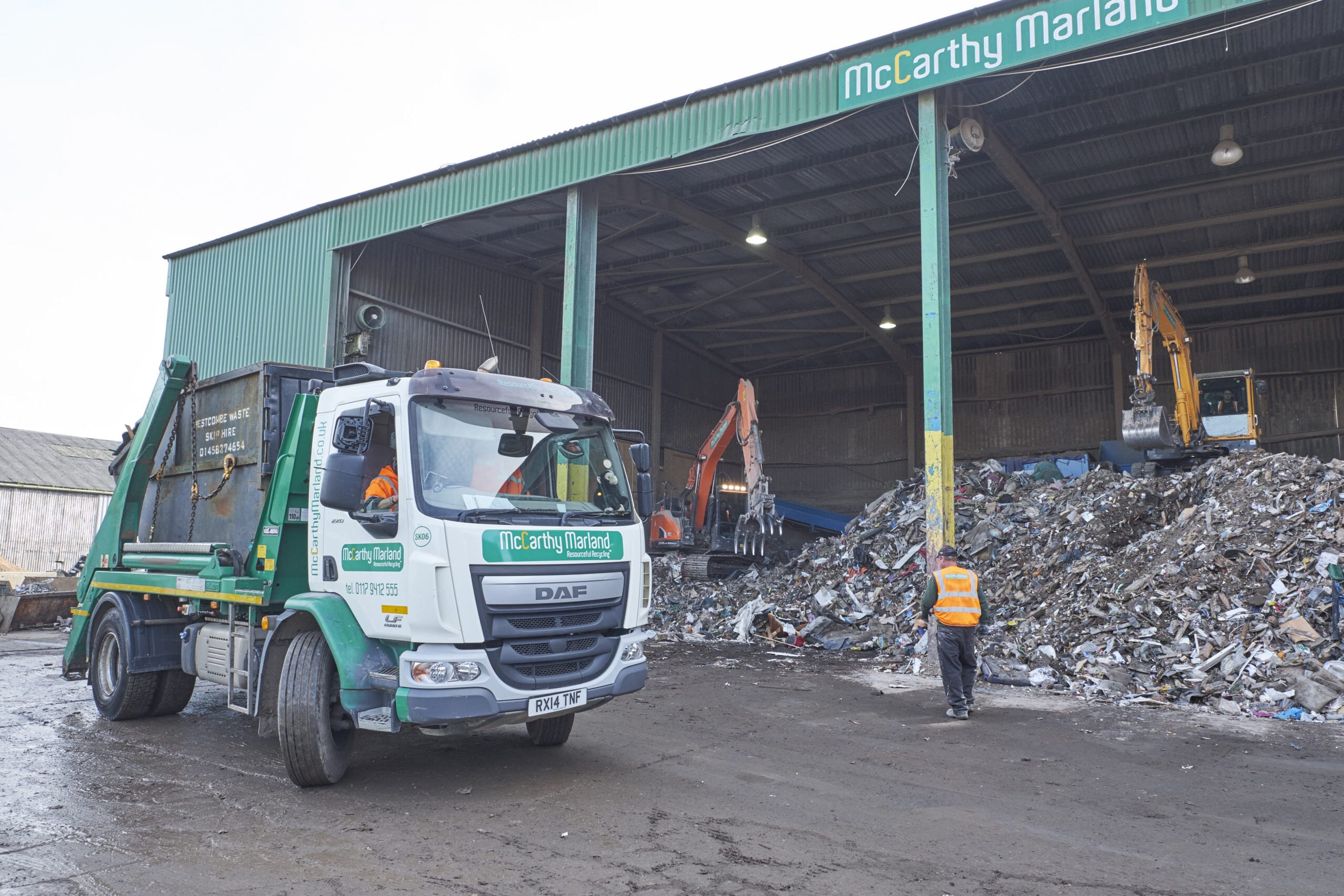
A new era in waste management has arrived! Westcombe Waste, Valley Trading, and Aasvogel are now officially trading as McCarthy Marland, combining their years of industry expertise under one trusted name. This move strengthens McCarthy Marland’s position as a leading waste management provider across the South of England.
When three became one
Westcombe Waste, Valley Trading, and Aasvogel are all highly experienced in providing waste management solutions to businesses and households across the region.
Established in the South West with a reputation for reliable waste collection and recycling services, Westcombe Waste became part of McCarthy Marland in 2017. Gloucestershire-based Valley Trading then followed suit and became part of McCarthy Marland in 2022, before Oxfordshire-based Aasvogel joined the family in 2024.
Now, all three businesses are fully integrated into the McCarthy Marland brand, allowing us to provide industry-leading waste management services to four distinct regions across the South of England (Bristol, Gloucestershire, Oxfordshire, and Somerset).
What this means for our customers
Customers of Westcombe Waste, Valley Trading, and Aasvogel can continue to expect the same high-quality service from the same trusted teams – just now under the McCarthy Marland name. This transition brings several key benefits to our customers, including:
- Coverage – a greater presence across the region with a larger fleet of vehicles and improved service capacity
- Services – more options for our core waste management services, including wheeled bins, skip hire, and roll-on roll-off (RoRo) containers
- Sustainability – increased investment in recycling infrastructure and waste reduction initiatives to help your business manage waste in an eco-friendly manner
At McCarthy Marland, we’re committed to delivering exceptional waste management solutions to businesses and households across the South of England. Get in touch with your local team for more information on our range of services.
What the 2025 landfill tax increase means for your business
From 1st April 2025, the UK government is set to introduce an increase to the landfill tax, which will mark one of the biggest jumps in landfill tax since its inception in 1996. With the new rates expected to impact businesses across multiple sectors, it’s essential that your company understands the changes and begins to improve its waste management strategies. We delve into everything you need to know about the increase in landfill tax for 2025 below.
What is the 2025 landfill tax increase?
The landfill tax is an environmental tax per tonne that is issued to all businesses and waste providers for waste disposed of in landfill sites. This government incentive was implemented back in 1996 to discourage waste from being sent to landfill. This is because as organic waste decomposes, landfills generate the harmful greenhouse gas known as methane, which is responsible for around 30% of the current rise in global temperature.
The current rates of landfill tax are:
- Standard landfill tax rate – £103.70 per tonne
- Lower landfill tax rate (for inert waste including certain soils and rocks) – £3.30 per tonne
As of 1st April 2025, the new landfill tax rates will be:
- Standard rate – £126.15 per tonne
- Lower rate – £4.50 per tonne
Why is landfill tax increasing in 2025?
This significant rise in landfill tax is part of the government’s ongoing efforts to align with the UK’s net zero goals. Along with the simpler recycling legislation, which aims to improve recycling rates for businesses and households, this increase will reduce the environmental impact of landfill waste and prompt businesses to adopt more sustainable waste management practices.
The new tax rate aims to:
- Prioritise recycling and reuse by encouraging businesses to divert waste from landfill and opt for more sustainable options such as recycling and composting
- Support the circular economy by driving businesses to think about their waste as a resource that can be repurposed rather than disposed of
- Reduce environmental damage such as soil and waste contamination, as well as harmful emissions from landfill waste decomposition
- Encourage businesses to explore alternative waste treatment methods such as waste-to-energy solutions and anaerobic digestion
How can your business prepare for the landfill tax increase?
1) Conduct a waste audit
Start by conducting a waste audit to understand what types of waste your business generates and how much of it is currently going to landfill. Identifying your current waste streams will help you determine where improvements can be made to your waste management strategies.
2) Improve your recycling rates
Recycling is a cost-effective and eco-friendly alternative to landfill. Ensure that your business has appropriately labelled recycling bins and that all staff are trained on which materials can be recycled. We offer a range of recycling and recovery bins that can help support your recycling efforts – check out our guide on wheelie bins for businesses for more information.
3) Consider a zero waste approach
Working toward a zero waste business model can help you avoid landfill costs altogether. This approach prioritises the 5 Rs of waste management: refuse, reduce, reuse, repurpose and recycle. Discover more in our blog on becoming a zero waste business in 2025.
4) Work with a responsible waste management provider
Partnering with a reliable waste management company like McCarthy Marland ensures that your waste is handled in the most sustainable and cost-effective way possible. By offering a comprehensive range of waste collection, recycling, and disposal services, we can help your business reduce its reliance on landfill.
Tailored waste solutions to help you navigate the 2025 landfill tax increase
With landfill tax rates set to rise significantly in April 2025, now is the time to take action. By implementing eco-friendly waste management practices, your business can not only reduce landfill costs but also contribute to a more sustainable future.
Our friendly team at McCarthy Marland are committed to helping your business navigate these changes with ease. We offer a wide range of commercial waste management services, including wheeled bin hire, skip hire, and roll-on roll-off (RoRo) hire, that are specifically designed to support your waste reduction goals.
For more advice on preparing for the landfill tax increase, speak to one of our team members today.
Commercial waste collection in Bristol, Gloucestershire, Oxfordshire & Somerset
Did you know that the UK generated 40.4 million tonnes of commercial and industrial (C&I) waste in 2020? With the UK producing such high volumes of waste, it’s essential that your business manages its trade waste in a responsible manner. Professional trade waste management can help you maintain health and safety standards in the workplace, whilst also complying with environmental regulations such as those set out under The Waste (England and Wales) Regulations 2011.
We are proud to offer comprehensive commercial waste collection services across Bristol, Gloucestershire, Oxfordshire, and Somerset. Discover more about our extensive range of waste management solutions below.
Tailored trade waste management solutions
At McCarthy Marland, we understand that every business has unique waste management needs. We offer a wide variety of flexible and reliable trade waste solutions that are specifically tailored to your business’ needs, including:
Wheeled bin hire
Our trade waste bin collection services are ideal for businesses that generate regular waste. We offer bins in various sizes (from 240L up to 1100L) and types (recycling & recovery, food, and glass) to accommodate different types of waste. Each bin also features a lockable lid for added safety and hygiene.
Skip hire
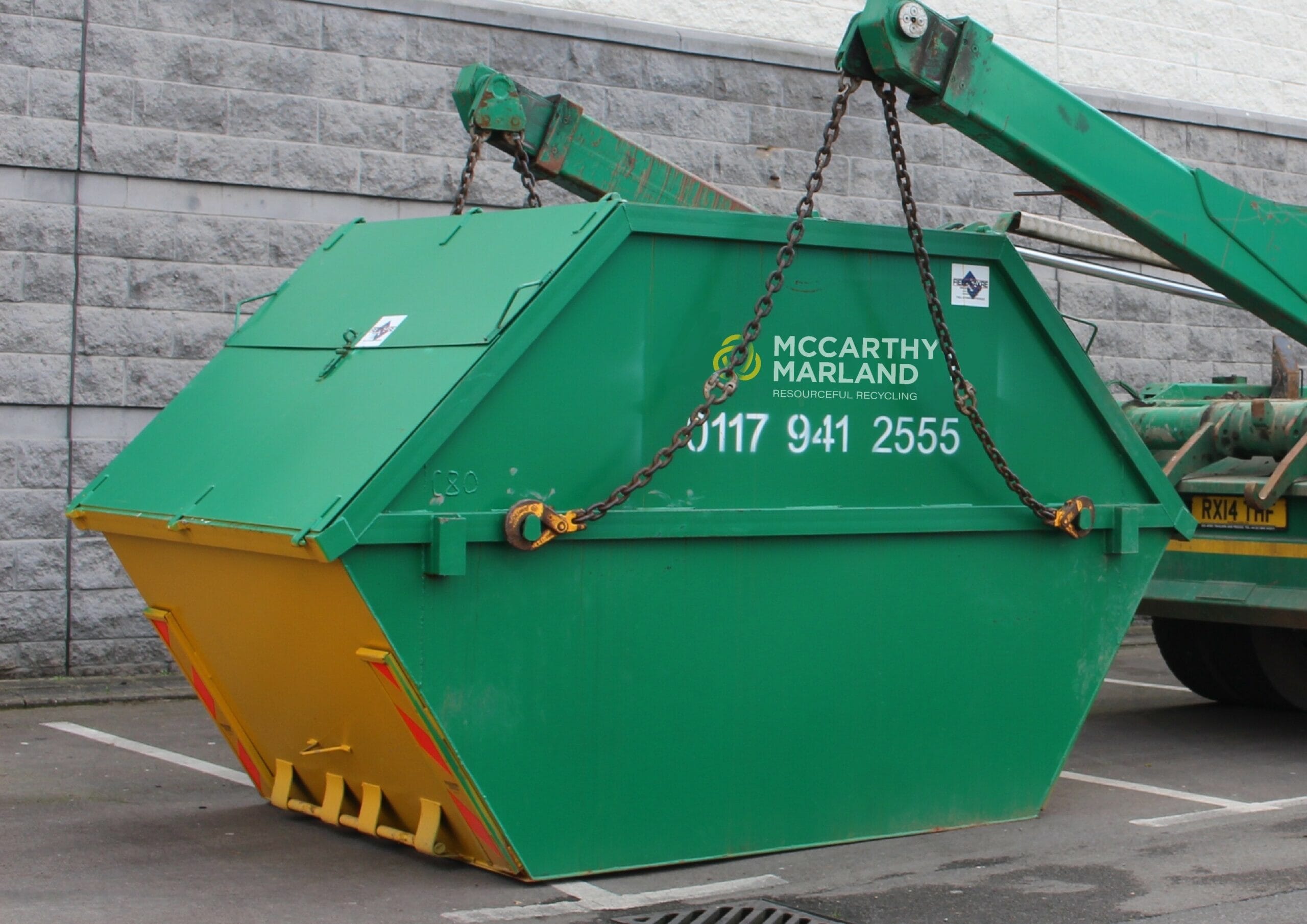
If your business has more substantial waste disposal needs, our skip hire services offer an excellent solution. Available in sizes ranging from 2 yard (mini) skips to 12 yard (open or closed) skips, our skips are perfect for managing waste from construction or industrial projects.
Roll-on roll-off (RoRo) collection
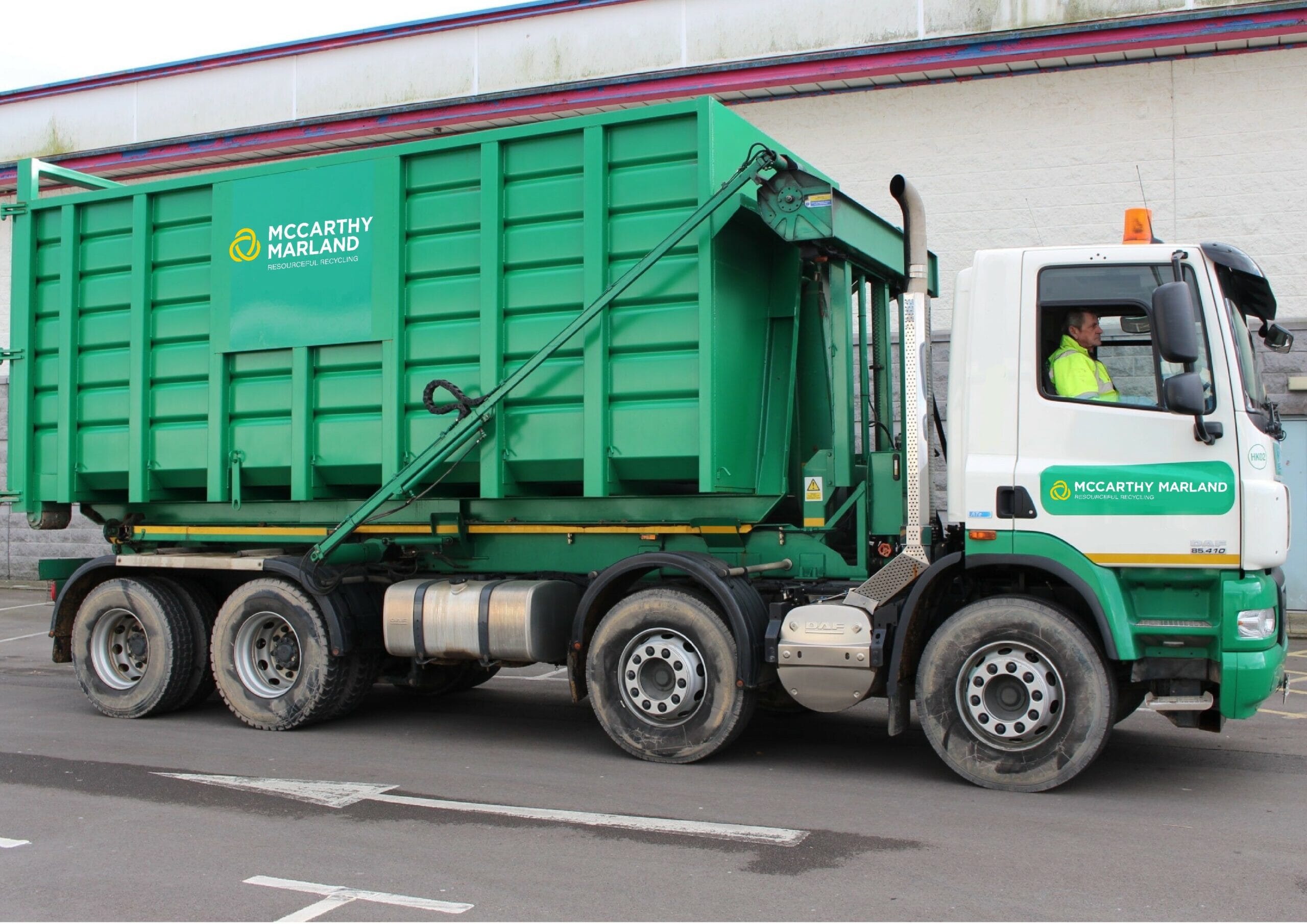
If you expect to generate more waste than our standard 12 yard skip can handle, consider opting for one of our RoRo containers. Available in various sizes, RoRo containers provide an efficient and cost-effective way to manage substantial waste loads from construction sites or manufacturing facilities.
Compaction systems
We also offer portable waste compaction systems for businesses who generate large quantities of dry packaging waste, including cardboard, paper, and plastics. They provide an efficient and hygienic disposal solution for businesses dealing with increased waste volumes.
Grab hire
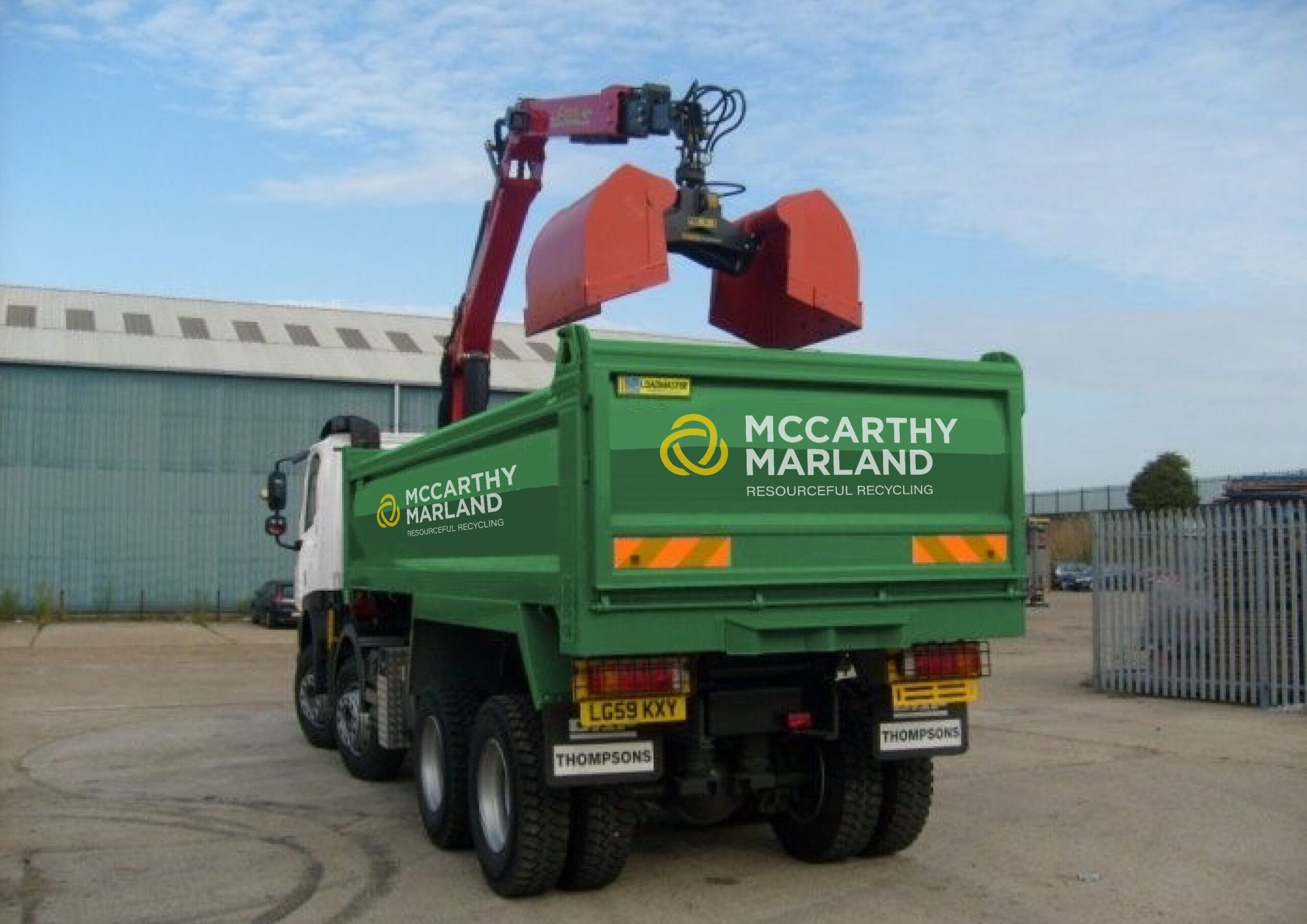
Our grab hire services are suitable for construction and landscaping businesses who wish to quickly dispose of substantial volumes of waste. Our grab lorries can remove soil, stone, and any other dug-out materials directly from your site, helping to minimise downtime and maximise operational efficiency.
Trade waste collection service areas
We provide reliable commercial waste collection services across several key locations in the South of England, including:
Bristol
Our Bristol waste recycling centre is centrally located in Albert Quay. Each year, the site processes approximately 80,000 tonnes of waste, including mixed municipal, construction, and industrial waste. We use a mixture of mechanical and manual sorting processes to recover the maximum amount of recyclable material possible.
Gloucestershire
Situated near Tetbury, our Gloucestershire waste recycling facility provides comprehensive waste solutions for both domestic and commercial clients. Our Gloucestershire team prides itself on handling your waste both professionally and responsibly, and we can even offer next-day skip hire for all your urgent disposal needs.
Oxfordshire
Our Wantage waste recycling centre facility delivers professional waste collection and disposal services to businesses across Oxfordshire, Berkshire, and Wiltshire. We ensure that all commercial waste is handled in compliance with the latest environmental regulations, and our Oxford waste collection team are proud to achieve an average recycling rate of 95%.
Somerset
Located near Somerton, our Somerset waste recycling facility is a front end transfer station with a landfill attached. It is equipped to handle a diverse range of trade waste, including wood, cardboard, rubble, soil, plasterboard, green waste, metals, plastics and residual waste. We offer both pay-as-you-go and credit account options, providing flexibility for businesses with varying waste disposal requirements.
Why choose McCarthy Marland for your commercial waste collection?
McCarthy Marland provides professional and reliable commercial waste collection services that are specifically tailored to your business needs. Our facilities are located in key areas across the South of England, including Bristol, Gloucestershire, Oxfordshire and Somerset. We ensure that all trade waste is managed in compliance with all the relevant regulations, so you can focus on doing what you do best – keeping your business running smoothly.
Sustainability is at the core of everything we do. We recycle an average of 95% of all waste we process, helping to divert significant volumes of waste from landfill. When you partner with McCarthy Marland, you can rest assured that your waste is being disposed of in an environmentally responsible manner.
Contact us today to arrange a free trade waste management consultation.
How to ensure responsible commercial and industrial waste management
Commercial and industrial waste management is a key issue facing today’s factories and manufacturing companies. Industrial processes generate large amounts of waste – the latest government statistics estimate that England alone produced around 33.6 million tonnes of commercial and industrial waste in 2022. It’s vital that your business manages its commercial and industrial waste in a safe and responsible manner to help reduce these shocking statistics.
However, effectively managing commercial and industrial waste presents several challenges for businesses, specifically regarding costs and environmental impact. We explore all things commercial and industrial waste management, and share some top tips on how to effectively manage your waste materials.
What is commercial and industrial waste management?
Commercial and industrial waste management refers to the collection and disposal of waste materials produced by manufacturing processes, including solid waste, liquid waste, chemical waste, and hazardous waste. Responsible commercial and industrial waste management practices involve recycling, reducing, and reusing materials wherever possible, allowing organisations to preserve our environment for generations to come.
Why is proper commercial and industrial waste management important?
Considering the fact that industrial waste can be hazardous, it’s crucial for businesses to practise responsible commercial and industrial waste management. This ensures that the waste materials your business produces do not cause human or environmental harm. Commercial and industrial waste management can help your business:
- Minimise pollution by preventing the release of harmful substances into our environment
- Conserve resources through recovering and reusing raw materials, reducing the need for new material creation
- Reduce its carbon footprint by using less energy and fewer resources throughout the production process
- Save money through the reduction of waste treatment and landfill tax costs
- Comply with legal regulations including The Controlled Waste Regulations 2012 and The Environmental Protection Act 1990
Our top 5 commercial and industrial waste management tips
Conduct a Waste Audit
A waste audit is a key step to improving your commercial and industrial waste management efforts. It allows you to assess the waste that your industrial setting generates during normal daily operations. We highly recommend measuring the amount of each type of waste that your business produces over a set amount of time, and pinpointing which area of your operations generates this waste i.e. manufacturing or packaging. This will then allow you to identify opportunities for waste reduction and recycling.
Prioritise Waste Reduction
Once you have conducted a waste audit, you should start considering ways to reduce the amount of waste generated at the source. For example, you could invest in newer equipment that is more efficient and produces less waste materials, or cut down on the amount of packaging your business uses. Regardless of which waste reduction strategies you choose, you should always train your employees on the latest processes to make sure everybody is on board.
Segregate & Recycle Your Waste
Properly segregating your commercial and industrial waste streams ensures that as much waste is recycled as possible and reduces the amount sent to landfill. You should install separate, clearly-labelled bins for each type of waste your business produces i.e. hazardous waste, recyclable waste and non-recyclable waste. Educate your staff on the importance of waste segregation and conduct regular reviews to evaluate the success of these practices.
Ensure Safe Storage & Handling
Safely storing and handling your commercial and industrial waste benefits both environmental and human health, helping to prevent accidents and reduce contamination. Each bin that houses your waste should be robust and leak-proof, preferably with lockable lids. This is especially important when storing hazardous industrial waste. Make sure that you have a clear emergency plan in place for dealing with any accidental spillages, and regularly inspect your waste storage areas for contamination.
Partner with a Commercial and Industrial Waste Management Provider
Working with a certified commercial waste management company like McCarthy Marland is crucial for guaranteeing the responsible disposal of your waste, especially when it comes to hazardous waste management. Make sure that your chosen partner complies with all the current regulations, and has an up-to-date waste management and waste carriers licence. Assess their overall reputation by reading customer reviews and case studies, and don’t be afraid to get in touch if you have any questions about their services.
Discover McCarthy Marland’s commercial and industrial waste management services
Here at McCarthy Marland, we are committed to helping businesses improve their sustainability efforts. We offer a wide range of cost-effective commercial and industrial waste management services that are specifically tailored to the unique needs of your premises, including wheelie bin hire, skip hire, and waste collection. Our team of experts ensures the safe and compliant removal of hazardous waste, leaving you with one less thing to worry about.
By choosing McCarthy Marland as your commercial and industrial waste management partner, you can rest assured in the fact that you are helping protect our environment for future generations to enjoy. Contact us today to discover how we can help manage your commercial and industrial waste materials.